
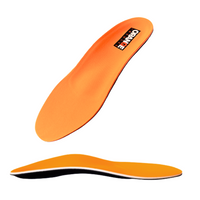

Insoles for basketball will not add inches to your vertical. What they change is the other half of the jump: how much force your feet, ankles, and knees absorb on the way down.
Basketball produces two loads most footwear handles poorly: repeated landings on a surface with no give, and hard lateral cuts. The foam liner in your shoes was built to a cost target, not to those loads.
Insoles Change How You Land, Not How High You Jump
Jump height comes from the force your legs produce and how fast they produce it. Foam under your foot changes neither.
A supportive insole changes three things: how widely landing impact spreads, how well your foot holds its position when you plant and cut, and how quickly your feet break down over a game.
Key takeaway: Insoles do not raise your vertical. They change how much of each landing your body absorbs.
Landing on Hardwood Loads Your Feet Differently Than Running Does
Running repeats one landing a few thousand times. Basketball gives you jump landings, hard stops, pivots, and sideways push-offs on hardwood laid over concrete, which returns nearly all the force you put into it.
The results cluster in predictable places: heel pain from landing impact, arch fatigue from the strain of cutting, stress fractures when volume climbs faster than tissue adapts, and plantar fasciitis, inflammation of the band of tissue along the bottom of the foot, from arches flattening under load. Sore heels first thing in the morning are the early sign, and stretching the arch before it becomes a problem belongs alongside better support.
Key takeaway: Landings and lateral cuts on an unforgiving surface are why court foot problems cluster in the heel and arch.
Arch Support Is What Holds Your Foot Steady Through a Cut
When you plant to change direction, your arch takes the load sideways as well as straight down. It flattens, and your foot rolls inward. That inward roll is called pronation, and some of it is normal. Past a certain point the ankle, knee, and hip start compensating for motion the foot was supposed to control.
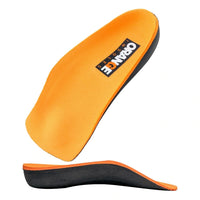
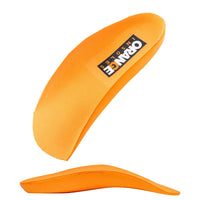
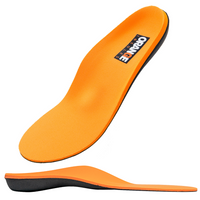
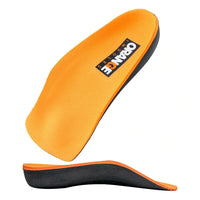
Medial arch support, meaning support built along the inside edge of the foot, limits how far that roll goes. Orange Sport is built around it, and the payoff is less about how the first step feels than about your foot sitting in the same position on the hundredth cut as it did on the first: better alignment, less fatigue, steadier footing. A built-in metatarsal pad, a low rise under the ball of the foot, spreads pressure across the forefoot instead of concentrating it where you push off. However, none of this makes an ankle sprain-proof.
Foam matters here for durability rather than support. Orange Insoles builds on O-FOAM, which returns about 40% more energy than traditional EVA, the soft foam most factory liners use, and lasts roughly three times as long. If you are weighing options, which foams hold up and which pack down is worth ten minutes.
Key takeaway: Arch support limits how far your foot rolls inward on a cut, which is what keeps your footing steady deep into a game.
A Bulky Insole Can Cost You the Lockdown Your Shoes Were Built For
Basketball shoes are built deliberately low in volume. The snug fit holds your foot over the footbed so it does not slide during a cut.
Most players who go looking for insoles, or shoe inserts for basketball as many people call them, hit one of two walls: enough structure to do the job and the heel floats, or slim enough to fit and it does nothing.
That gap is why Orange Sport exists as its own model rather than a version of Orange Full. It carries real arch support on a slim athletic profile made for running shoes, cleats, and other close-fitting athletic footwear, so the shoe still closes down around your foot. If you are choosing between the two, the comparison covers who each one is for.
Then check the fit:
-
Pull the factory liner all the way out. Never stack a new insole on top of it — that is where most fit problems start.
-
Drop the new insole in and lace up as tight as you actually play.
-
Rise onto your toes. Your heel should stay seated in the counter, not lift out of it.
-
Check the front. Your longest toe should not press into the end of the shoe while you stand laced in.
Key takeaway: Remove the factory liner rather than stacking, choose a profile built for close-fitting athletic shoes, then check heel hold and toe room with the shoe laced tight.
Most of What You'll Notice Shows Up in the Fourth Quarter
Foam liners compress. After a few months of practice they stop rebounding, and tired feet move differently: landings get sloppier, the first step off a cut loses a little snap.
Soreness that clears overnight is ordinary fatigue. Pain in the same spot every session is a different signal, and telling those apart is worth learning.
A finished liner is easy to spot: an arch that gives under thumb pressure, a profile pressed flat, a dark wear patch where the foot loads hardest. Athletic shoes break down faster than most players expect, and the insole goes first.
Key takeaway: A packed-out liner shows up as fatigue before it shows up as pain. Press on the arch a few times a season.
The Pair You Keep Is the One You Stop Noticing
What makes a player loyal to one insole is rarely anything to do with jumping. It is heels that stop aching after a doubleheader, and feet that feel the same in the fourth quarter as the first.
Get More Out of the Fourth Quarter
If your feet are cooked by the second half, the support under them is worth checking first. Orange Sport was built for the cutting, landing, and repeated impact that court sports ask of a foot. Orange Insoles backs every pair with a 60-day guarantee and free returns.