

The clearest sign you are ready to run again is 30 minutes of brisk walking with no pain during it and none the next morning. Not week six on the calendar. Not the day your limp disappears.
A return to running tends to go wrong in one of two directions: starting again the week the pain stops, or holding back so carefully that the tissue never gets loaded enough to rebuild. The tests below keep you out of both.
Your Doctor or Physical Therapist Sets the Timeline
Get cleared before you run. Your doctor or physical therapist sets your timeline, and no general guide replaces the person who has seen your imaging.
Healing rates differ substantially by injury and by site. General clinical practice puts stress fracture healing at roughly 6 to 16 weeks depending on location and blood supply. A fifth metatarsal fracture (the long bone behind your little toe) and a navicular one (a small bone at the top of your arch) are not the same recovery. Soft tissue injuries follow their own course. A number of weeks is context, not a green light.
Key takeaway: Clearance comes first. A date on the calendar is not a readiness test.
Every Readiness Test Is Asking a Question About Your Foot
Before your first run back, you should be able to:
-
Walk briskly for 30 minutes with no pain during or after
-
Do 20 to 30 single-leg calf raises on the injured side
-
Hop 10 times in a row on that leg, pain-free
-
Get through a normal day without limping or shifting weight off it
Every one of those tests loads your foot and asks it to absorb impact and give it back. They are foot-loading tests, which is the part of this that Orange Insoles can actually help with.
Key takeaway: Readiness is a list of things your foot can do, not a date it arrives at.
The First Five Weeks Are Intervals, Not Runs
Start at 1 minute of running and 1 minute of walking, repeated for 20 to 30 minutes. After two or three comfortable sessions, move to 3 minutes running and 1 walking, then 5 and 1. Only when 5 and 1 feels easy should you try 20 continuous minutes. Reaching 30 continuous minutes usually takes five weeks at minimum.
Leave at least 24 hours between runs, and no consecutive running days in these first weeks. Rest days are when tissue adapts to the load, so treat them as part of the plan. A few minutes of attention to your feet after a run also means you notice changes earlier.
If you are unsure how much is too much in that first week, easing back into training without triggering foot pain goes further into pacing. Once you are running continuously, hold weekly volume increases to about 10 percent.
Key takeaway: Walk breaks are how you build load tolerance without overshooting it.
Tomorrow's Soreness Tells You More Than Today's Run
During a run, keep discomfort at or below about 3 out of 10, and stop if it climbs instead of settling. Awareness of the area that fades as you warm up is different from pain that sharpens each mile.
If soreness has not settled within 24 hours, the last step was too much. Drop back one step, repeat it, and move on when it is quiet. Do not push through it. When you cannot tell whether what you feel counts as pain, the difference between foot fatigue and foot pain is a useful line to have.
A previous running injury is one of the strongest predictors of the next one, which is why dropping back a step is not lost progress. Old injuries resurface when someone rebuilds volume quickly after time off.
Key takeaway: Pain during the run sets your ceiling; soreness the next morning sets your pace.
What Is Under Your Foot Is the Part You Control
The timeline is not yours. Three things are.
Surface. Run early intervals on a treadmill, track, or smooth asphalt. Trails and cambered road edges ask your foot to stabilize in directions it has not handled for weeks.
Shoe mileage. The shoes you were injured in have absorbed every mile since you bought them, and athletic shoes break down faster than most runners expect. Check the heel and midsole first.
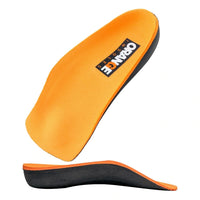
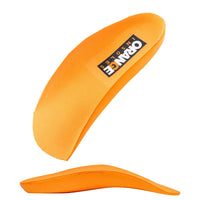
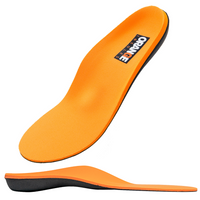
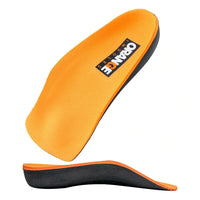
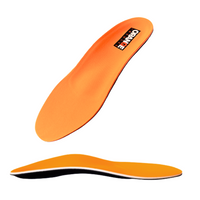
Support under the arch. Running loads your foot at roughly two to three times bodyweight per stride, on tissue that has been unloaded for weeks. Support changes how that load spreads across the foot instead of concentrating it in one place. The deep heel cup in Orange Insoles holds the heel in position at contact, where that distribution starts.
An insole does not heal tissue, speed up your timeline, or replace the rehab work your physical therapist gave you. It changes how load is distributed. That is a variable you can adjust this week, while the timeline stays with your clinician.
Key takeaway: Surface, shoe mileage, and arch support are the parts of the comeback you decide.
The Comeback That Sticks Is the Slow One
The runners who come back and stay back are usually the ones who spent five unremarkable weeks running one minute at a time. You will know it is working when the runs get boring: nothing hurts the next morning, and there is nothing to report.
Choosing Support for the Miles You Are Rebuilding
Rebuilding mileage asks something different from your feet than a normal training block. Our comparison of Orange Sport and Orange Full walks through which one fits which kind of activity, so you can choose before your first interval session.