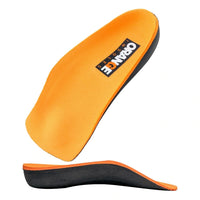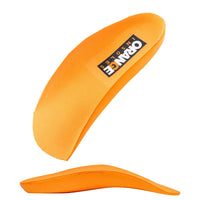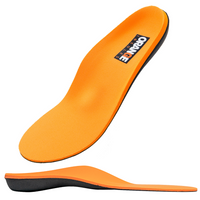
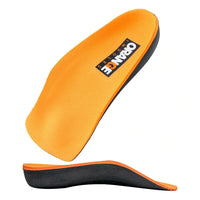

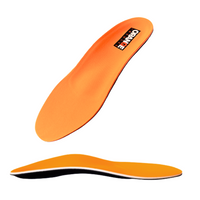

Finding the best insoles for boots, loafers, and flats usually starts with one simple question: how much room is inside the shoe?
Fall footwear comes in all kinds of shapes. Boots often have more interior space, while loafers and flats tend to have shallower interiors and tighter toe boxes. Some shoes have removable liners, while others have footbeds that are permanently attached.
Before choosing an insole, reach inside your shoe and gently pull up on the liner. If it comes out easily, you have more room to work with. If it stays firmly in place, you will want an insole that can sit inside the shoe without making the fit too tight.
The goal is to add support without changing the fit of the shoe so much that it becomes uncomfortable.
Removable Liners and Roomy Boots: Orange Full
Boots are often a good match for a full-length insole, especially when the factory liner can be removed.
If the liner lifts out easily, take it out before adding the Orange Full Length Insoles. Orange Full is designed to replace the existing liner rather than sit on top of it.
That distinction matters. Stacking one full-length insole on top of another can raise your foot too high inside the boot and create pressure across the toes or top of the foot.
Once the Orange Full is in place, your foot should still feel secure and comfortable. Your toes should have room to move, and your heel should stay seated properly inside the shoe.
Orange Full can work well in everyday boots, walking shoes, and other footwear that has a removable liner and enough interior depth.
Glued-In Footbeds: Orange Light
Flats, slip-ons, and many casual shoes often have liners that cannot be removed.
If the footbed is glued or permanently attached, do not try to pull it out just to make space for a new insole.
Instead, you need to work with the room that is already available inside the shoe.
Orange Light can be placed inside the existing footbed, making it an option for footwear where replacing the original liner is not possible.
This can be especially useful when looking for insoles for flats or other low-profile shoes. These styles usually have less vertical space than boots or sneakers, so adding too much material can quickly make the shoe feel tight across the top of the foot.
Even with a thinner insole, the shoe should still fit naturally. If adding an insert causes noticeable pressure or crowding, the shoe may simply not have enough room for that type of support.
Tight Loafers: Orange 3/4
Loafers can be difficult to fit with a full-length insole because they often have shallow toe boxes.
Even when there is enough room around the heel and arch, adding another full layer underneath the toes can make the front of the shoe feel cramped.
In this situation, Orange 3/4 may be a better option.
The shorter design provides support through the heel and arch while leaving more room toward the front of the shoe.
This can make it useful for loafers, dress shoes, and other footwear where forefoot space is limited.
As with any insole, make sure it sits securely inside the shoe. It should not slide forward or shift around as you walk.
Thick Socks Change the Fit
The way a boot fits in early fall may be very different from the way it fits once you start wearing thick winter socks.
Heavy socks take up additional space inside the shoe, so always test your boots with the socks you actually plan to wear.
If the boot becomes tight after adding the insole, do not automatically size down the insole or start stacking different inserts to adjust the fit. The support should still line up properly with your foot.
Likewise, if a boot is too loose, adding extra insoles just to fill empty space is not the best solution. If the footwear is significantly too large or too loose, the better answer may be a properly fitting shoe or boot.
Do Not Stack Insoles to Fix a Loose Shoe
It can be tempting to add another liner or insole when a shoe feels too roomy.
That may make the shoe feel tighter temporarily, but stacking insoles is not the same as having a properly fitting shoe.
Adding too many layers can raise the heel, crowd the toes, and change the position of the foot relative to the support built into the insole. It can also make the shoe feel unstable.
If the original liner is removable and you are using Orange Full, replace the liner rather than stacking Orange Full on top of it.
If the shoe is simply too large, an insole should not be used as a substitute for proper sizing.
How Do You Know If the Insole Is Too Thick?
Your shoes will usually tell you.
If your toes feel compressed, the top of your foot feels squeezed, or your heel starts slipping out of the shoe, the insole may be taking up too much space.
You should also make sure the insert stays securely in place while you walk.
New support can feel different at first, so give your feet time to adjust. Start by wearing your Orange Insoles for shorter periods and gradually work up to longer wear.
Find the Right Fit for Your Fall Shoes
The best insole for a boot, loafer, or flat depends on how the shoe is built and how much space is available inside it.
Boots with removable liners and enough depth may work well with Orange Full. Shoes with permanent footbeds may be better suited to Orange Light, while loafers and other shoes with limited forefoot space may work better with Orange 3/4.
Start with the shoe, not the insole. Check the liner, check the available space, and make sure the final fit still feels natural.
Not sure which one works with the shoes you already own? Use the Insole Selector to find the Orange Insole that best matches your footwear.