
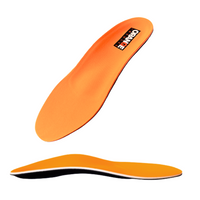

The best insoles for standing all day are the ones your shoe has room for. Take out the liner that came with your work shoes, look at the space it leaves, and you have most of your answer before comparing a single product.
Eight to twelve hours upright on concrete or tile flattens the arch and leaves the heel sore, and the fix is support that holds its shape for a full shift. If the shoe itself is the problem, worn flat or with no structure left, an insole will not rescue it.
The Room Left in Your Shoe Decides Which Insole Survives the Shift
Pull the insert out of the shoes you wear to work. Anyone who has spent years fitting shoes on a retail floor starts there, because it decides everything after it.
You will find one of three things:
-
It lifts out cleanly and leaves a deep footbed. Real room.
-
It lifts out, but the shoe was snug to begin with. Room is tight.
-
It is glued down. Anything you add sits on top of it, so it has to be slim.
An insole the shoe cannot fit gets pulled out by week two no matter how good its arch is. Add too much height and the toes press into the toe box and the heel rides up on every step. Shoe volume — the space left once the factory liner is out — differs enormously between a warehouse boot and a slip-resistant kitchen shoe.
Key takeaway: The insole that helps at hour ten is the one your shoe had room for at hour zero.
Match the Insole to What the Liner Left Behind
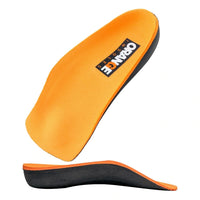
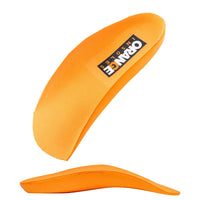
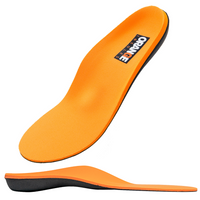
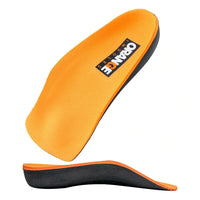
The Orange Insoles line is built around that question rather than cushioning grades:
-
Real room after the liner comes out: Orange Full, the full-length model, or Orange Sport if you also train after your shift.
-
A toe box that cannot give up any height: Orange 3/4, which runs heel-to-arch and stops before the forefoot.
-
A tight shoe, or a liner that is glued in: Orange Light, the slimmest of the four.
Steel-toe boots are their own case: the protective cap fixes the height over your toes, so comfort in a steel-toe boot depends on forefoot bulk more than arch shape. Nursing shoes and clogs have their own quirks, which our guide to insoles for nurses covers in more detail.
Key takeaway: Pick the support your workload needs, then the thickness your shoe can accept.
Firm Support Is What Still Works at Hour Eight
For standing all day, choose firm. Soft cushioning compresses under body weight, which lets the arch settle downward, so an insert that feels plush in the store has stopped supporting much by mid-shift. Firm structured support holds the foot's shape for the full eight hours, with cushioning sitting on top of that structure rather than replacing it.
A deep heel cup is the part of that structure you feel first on a hard floor. It cradles the fat pad under your heel bone instead of letting it spread outward with each step, which is where much end-of-shift heel soreness starts.
When the arch gives way over a long shift, that change in alignment travels upward, which is why a lower back that aches by clock-out often starts at the floor.
Key takeaway: Soft wins at minute five; firm is still working at hour eight.
Two Pairs of Work Shoes Outlast One
Give a new insole a few short days before a full shift. Your foot needs up to a week or two to adapt to a new position, and a mild ache along the arch is ordinary. Sharp pain is not, and usually means the wrong model for the shoe.
After that, the biggest thing you control is how often the same pair goes back on. Rotating between two pairs of work shoes gives the foam a day to decompress, and the insoles inside last longer for it.
Plan on replacing work insoles around six to nine months of daily wear, possibly sooner on concrete. Set one on a flat table: if the arch has gone flat or the heel cup has creased, it is likely time for a new pair. Spending more up front generally buys firmer support and more months of it.
Key takeaway: Two pairs in rotation and a table-top check every few months is most of it.
Your Work Shoes Have Already Narrowed the List
Most people standing all day have never taken the factory liner out of the shoes they stand in. It takes ten seconds and turns a wall of similar-looking products into the two or three that fit. If some workdays leave your feet worse than others, the shoes you had on are usually the variable.
Find the Insole Your Work Shoes Can Take
Standing all day gets easier when your feet are supported at hour ten the way they were at hour one. Orange Insoles makes four models, so there is a fit for the shoes you already wear to work, whatever room they have left. The guide to choosing an insole walks the same fit questions in two minutes. Feel better, do more.